Understanding Emotions
“How are you feeling about it?” “Fine.” “Stressed.” “Not great.” Most of the time, these are the words we have for what we feel.
The problem is that they say very little. “Stressed” can mean worried, overwhelmed, irritated or disappointed, and each of these points to a different situation and a different response. Emotions carry information about what matters to us. To use that information, we first need to notice what we are feeling, and then find a more precise word for it.
This exercise helps you do both, and then decide what to do.
Why naming matters
Putting a feeling into words is not just a matter of vocabulary. In a 2007 study published in Psychological Science, Matthew Lieberman and colleagues found that labelling the emotion in emotional images reduced activity in the amygdala, a brain region involved in emotional reactions, compared with other ways of processing the same images.
A laboratory study does not translate directly into everyday life, but it supports something many people notice for themselves: once you can say exactly what you feel, the feeling becomes easier to think about.
The four steps
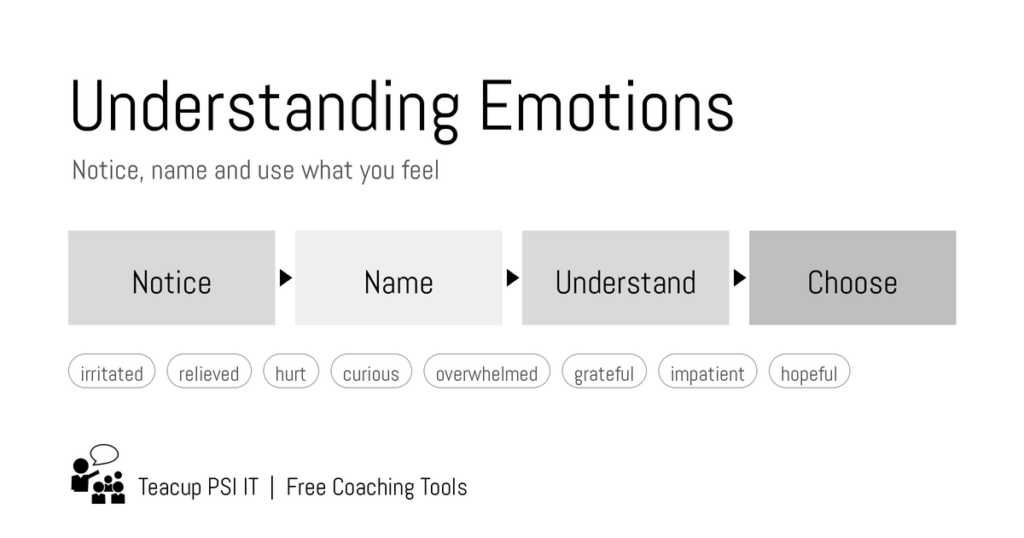
Step 1. Notice
Where do you feel it in your body? Tension in the shoulders, heat in the face, a knot in the stomach, a heavy chest. Sometimes the body notices before the mind does. Paying attention to these signals is often the first clue that something is going on.
Step 2. Name
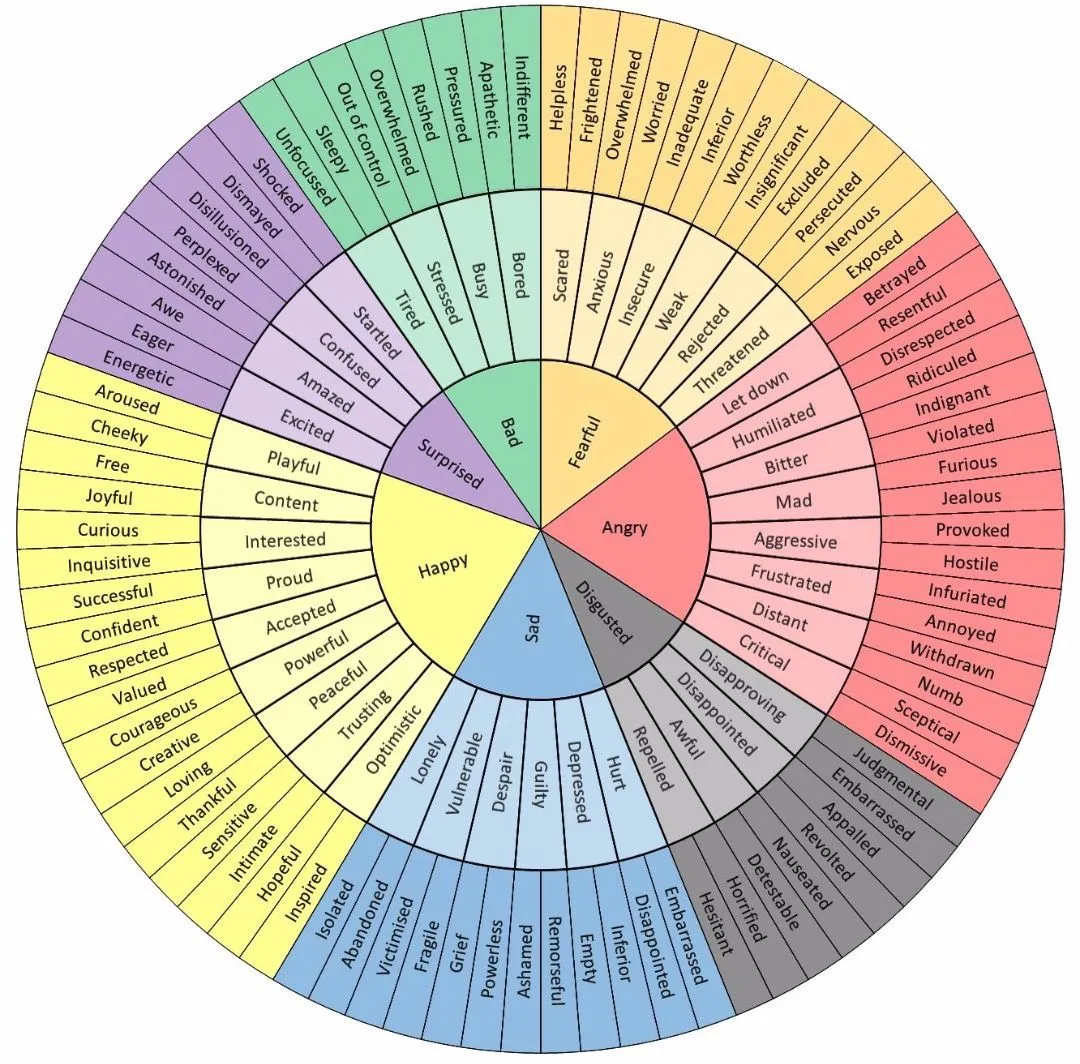
What exactly are you feeling? Try to go beyond “good”, “bad” or “stressed”. The worksheet includes a list of words grouped into families: if you start from “angry”, you might find that “irritated”, “resentful” or “impatient” fits better. Emotions can also mix, so more than one word may be right.
Step 3. Understand
What is this emotion telling you? Frustration often signals that something you care about is being blocked. Unease can mean that something does not add up. Ask yourself: what matters to me in this situation?
Step 4. Choose
What do you want to do now? Noticing and naming an emotion creates a small space between feeling it and acting on it. You do not have to react straight away: you can decide what response serves you best.
How to use the worksheet
For one week, use the emotion log whenever a situation leaves a mark, at work or elsewhere. Write down the situation, what you noticed in your body, the word that fits best, what the emotion was telling you, and what you did or could do.
Start with everyday situations: a meeting, an email, a conversation. At the end of the week, look back and notice which emotions came up most often, in which situations, and what they were telling you.
An example
In a meeting, a colleague presents Marta’s idea as his own. She notices heat in her face and a tight jaw. Her first word is “angry”. Looking closer, she finds that “irritated” and “hurt” fit better.
What is the emotion telling her? That she cares about her work being recognised. In the moment she said nothing, and later complained to a friend. Looking back, she sees other options: talking to her colleague privately the next day, and sharing her ideas in writing before meetings.
Moving from “angry” to “irritated and hurt” changed what Marta needed: not to win an argument, but to have her contribution recognised. That points to a different, more useful conversation.

Tips
- Short notes are enough. The log works because you use it regularly, not because you write a lot.
- There are no wrong emotions. The aim is to understand what you feel, not to judge it.
- Look for patterns, not single episodes. One situation tells you little; the same emotion in similar situations tells you a lot.
- Keep it to everyday situations. This exercise is not the place to go back over painful experiences.
A note on limits
This is a coaching exercise, designed to help you use your emotions in decisions and everyday situations. It is not therapy, and it is not a way to work through past experiences. If your emotions feel overwhelming, or low mood or anxiety persist, please speak to a qualified professional.
When to use another tool
If what you notice points to a decision you need to make, the Weighted Decision Matrix can help you weigh your options. If it points to something you want to change, G.R.O.W. can help you turn it into a goal and a first step.
And if you would like to explore this in conversation, that is what a coaching session is for.