G.R.O.W.
Some goals are clear from the start. You know what you want: a new role, a finished project, a conversation you have been putting off. What is missing is the way from here to there.
G.R.O.W. is a sequence of four questions that helps you find it. You can work through it in a coaching session, or on your own, with a pen and the worksheet below.
Download file:
Where it comes from
The GROW model was developed in the 1980s by the business coaches Graham Alexander, Alan Fine and John Whitmore. It became widely known through Whitmore’s book Coaching for Performance, still the standard reference on the model.
The four steps
G — Goal: what do I want?
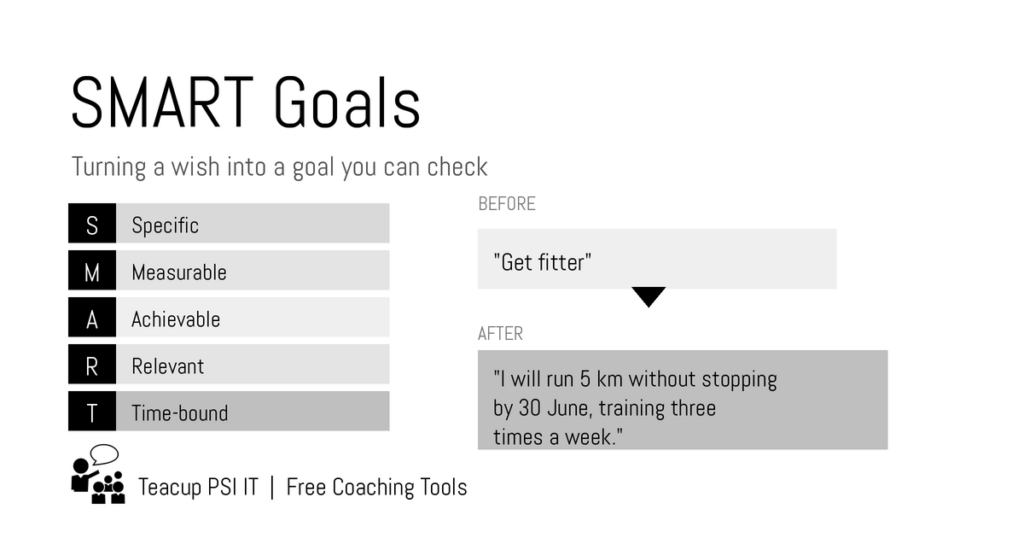
Start by saying what you want, in one or two sentences. Make it concrete enough that you would recognise it when you get there. “A better job” is a wish; “a role where I lead a small team, within a year” is a goal.
- What exactly do I want to achieve?
- How will I know I have achieved it?
- By when?
- Why does this matter to me?
R — Reality: where am I now?
Before looking for solutions, describe where you are. Facts, not judgements. This step is often rushed, and it is where many of the answers are: once the situation is described clearly, part of the way forward often becomes visible.
- What is happening now?
- What have I already tried, and what happened?
- What is helping me, and what is holding me back?
- What is missing?
O — Options: what could I do?
Now list what you could do. Write down every option, including the ones that seem unrealistic: judging comes later. When you have a list, look at the advantages and costs of each one.
- What could I do? What else? And what else?
- What would I do if one constraint were removed: time, money, other people’s opinion?
- What would I advise a friend in my position?
- What are the advantages and costs of each option?
If you end up with several good options and cannot choose between them, the Weighted Decision Matrix can help.
W — Will: what will I do?
The last step turns options into commitments. Choose what you will do, when you will start, and what might stop you.
- What will I do, and when? What is the first step I can take this week?
- What could get in the way, and how will I deal with it?
- From 1 to 10, how committed am I? If less than 8, what would raise it?
An example
Luca works in marketing and would like to move into a role closer to data analysis.
Goal. “Within twelve months, I want to be in a role where at least half of my time is spent on data analysis.”
Reality. He uses spreadsheets every day but has no formal training in analytics tools. His company has a small data team. He once started an online course but stopped after three weeks, when work got busy.
Options. Take a course with weekly deadlines. Ask to join a project with the data team. Look for analyst roles at other companies. Build a small portfolio using his own campaign data.
Will. This week he will ask his manager about joining the data team’s next project, and by the end of the month he will enrol in a course with weekly deadlines. The risk is the same as last time, a busy period at work, so he blocks two fixed evenings a week in his calendar. Commitment: 8 out of 10.
Notice what happened in Reality: naming why the first course failed shaped the plan in Will. This is why the Reality step is worth the time.
Tips
- Take your time on Reality. Most people rush it to get to the solutions.
- Follow the order, but not rigidly. If the Options show that the Goal was wrong, go back and rewrite it.
- Write your answers down. Thinking in circles is easier in your head than on paper.
- Keep the first step small. A step you can take this week is worth more than a perfect plan.
When to use another tool
G.R.O.W. works when you know what you want. If you are not sure yet, start with the Wheel of Life. If you know your options and cannot choose, use the Weighted Decision Matrix.
And if a goal keeps you stuck despite every tool, it may be worth talking it through. That is what a coaching session is for. Coaching is not a substitute for professional help: if a situation is causing you significant distress, please speak to a qualified professional.