SMART Goals
“Get fitter.” “Improve my English.” “Be more organised.” We all set goals like these, and most of them quietly disappear. Not because we lack willpower, but because they are not goals: they are wishes. There is no way to tell whether you have reached them, or when, or what to do first.
SMART is a way of rewriting a wish as a goal you can actually check.
Download file:
Where it comes from
The acronym was introduced by George T. Doran in the November 1981 issue of Management Review, in an article about how managers should write objectives. In the original version the letters stood for Specific, Measurable, Assignable, Realistic and Time-related. The version used today, with Achievable and Relevant, came later.
There is also research behind the idea. Reviewing 35 years of studies on goal setting, Edwin Locke and Gary Latham reported in American Psychologist in 2002 that specific and difficult goals consistently led to better performance than asking people to do their best, which gives no reference point for what counts as success.
It is worth saying what SMART does not do. It helps you phrase a goal well. It does not tell you whether that goal is worth having, and it says nothing about how ambitious it should be. Not everyone who studies goal setting thinks the five criteria are necessary.
The five questions
S — Specific
What exactly will you do? Who is involved, and where? “Do more sport” could mean anything. “Run”, “swim twice a week” or “join the Tuesday football game” are things you could picture yourself doing tomorrow.
M — Measurable
How will you know you have done it? Find something you can count or check: a distance, a number of sessions, a finished document, a conversation that has taken place. If you cannot say how you will know, the goal will stay vague.
A — Achievable
Is it possible with the time, money and skills you have? If not, what would you need, and can you get it? This is not about aiming low. It is about knowing whether you are setting yourself up for success or for disappointment.
R — Relevant
Does it matter to you right now? Does it fit with the rest of your life and your other commitments? A goal that belongs to someone else, or to a version of you from three years ago, rarely survives a busy month.
T — Time-bound
By when? And when will you check your progress? A goal without a date is a goal you can always start next week.
How to use the worksheet
Step 1. Name the change
Write down the change you are going through, roughly when it started, and whether you chose it.
Step 2. Find where you are
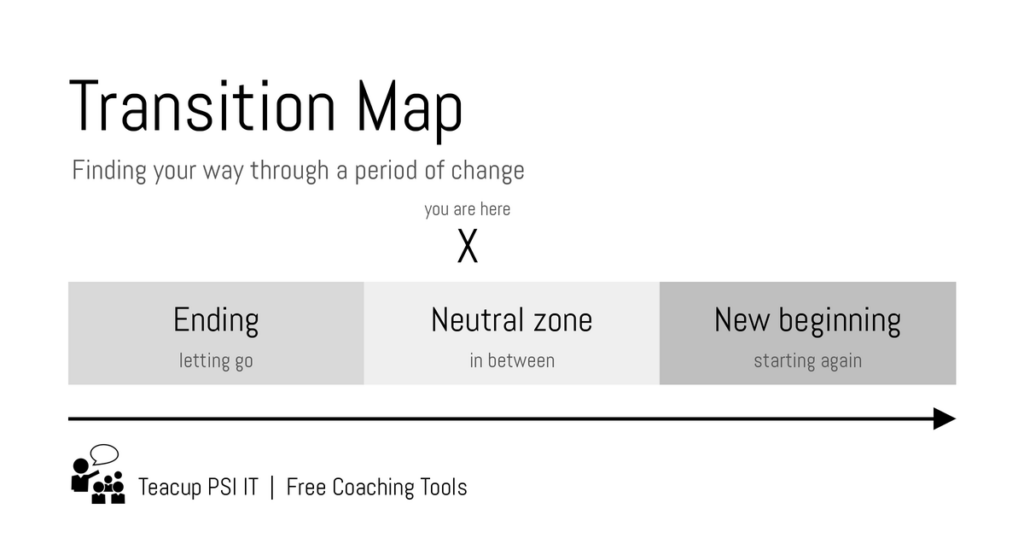
Mark on the map where you feel you are today, and tick the statements that sound like you. For example, “I know what is over, but not yet what comes next” is typical of the neutral zone.
Step 3. Answer the questions for your phase
- Ending: What exactly has ended? What am I leaving behind, and what can I take with me?
- Neutral zone: What am I noticing about myself in this in-between time? What small experiment could I try, without committing to anything yet? Who could I talk to about this?
- New beginning: What first signs of the new situation am I noticing? What is one step that would help me commit to it?
You can come back to the other phases later.
An example
Chiara wants to get back into shape after a long break. She starts from “get fitter” and works through the five questions.
What exactly? Running, not “sport”. How will she know? The distance, and no walking breaks. Is it possible? Yes, with three sessions a week over four months. Does it matter now? Yes: she wants her energy back. By when? The end of June.
Her goal becomes: “I will run 5 km without stopping by 30 June, training three times a week.”
She then sets two milestones, 2 km by the end of March and 3.5 km by the end of April, so she does not have to wait until June to know how it is going. Her first step is to book the first three runs in her calendar this week. Her obstacle is rain and late meetings, so she keeps a spare slot on Saturday morning.
Common mistakes
- Measuring the activity instead of the result, or the other way round. “Three gym sessions a week” measures effort; “run 5 km” measures the outcome. Both can work, but choose on purpose.
- Turning “achievable” into “unambitious”. A goal you are sure of reaching may not be worth the effort of writing down.
- No milestones. With a date six months away and nothing in between, you find out too late that you are behind.
- Rewriting the wish without changing anything. If the new sentence still does not tell you what to do on Monday, it is not finished.
When to use another tool
SMART is for the wording of a goal, not for choosing it. If you do not yet know which goal to set, start with the Wheel of Life. If you know what you want but not how to get there, G.R.O.W. takes you from the goal to a plan, and the Goal step works well with this worksheet. If you are choosing between several possible goals, try the Weighted Decision Matrix.
And if you would like to work on a goal in conversation, that is what a coaching session is for. Coaching is not a substitute for professional help: before starting a demanding physical goal, speak to a doctor if you have any health concerns.